Monday, 22 July 2019

Duryan's 405 Perfidious Perfumes

About Duryan the Gardener 


Duryan was an adventuring wizard before finding his true passion in gardening. Now, he has no interest in discussing spell-lore, having patience only for the language of plants. His garden is filled with flowers of shifting hues, trees bearing strange fruit, and grasses that seem to move with intelligence.

Of course, there are things he wants from you to make his garden even greater. For example: go find a black lotus from a place with a strong presence of death, then take the flower to a druid to have its necrotic energy neutralized, so that Duryan can safely plant it. When you complete any such task for Duryan, he will present you with a new perfume distilled from the good things from his garden.
 

Random Perfume Tables


Duryan produces only 1d4 doses of perfume each time. Each perfume has unique properties when applied to a subject’s skin, but the properties’ nature can only be discovered through experimentation.

When a perfume is first applied, the referee rolls for a random duration, effect and name for the new scent.
 
d6
Perfume Duration
1-2
6+2d6 hours
3-4
1d6 days
5-6
2d6 days

d10
Perfume Effect
1-5
Potent Pheromone
6
Awful Allergy
7
Signature Scent
8
Magiphobic Coating
9
Flammable Fumes
10
Utter Ecstasy

Potent Pheromone: Roll twice on the creature type table. The first creature type is enamored by the scent; the second is revolted. Treat reaction rolls with enamored creatures as an automatic result of 12 (enthusiastically friendly), and with revolted creatures as an automatic result of 1 (hostile, non-civilized creatures immediately attack and civilized creatures treat you as if you just loudly soiled yourself in front of them).

If the same creature type is rolled twice, then the scent is physically harmful to that creature: people will suffer violent nosebleeds and run away in terror, undead are destroyed or dispelled, etc. If the subject to which the perfume is applied happens to be on that type, then it’s bound to be bad: they take one die of damage per round until the perfume is washed off.

d20
Creature type
1
Human males
2
Human females
3
Dwarves
4
Elves
5
Halflings
6
Goblinoids
7
Orcs and trolls
8
Kobolds and lizardfolk
9
Lizards and snakes
10
Dogs, wolves, werewolves, bears, badgers, etc.
11
Cats, tigers, weretigers, hyenas, gnolls, mongooses, etc.
12
Rodents and monkeys
13
Horses, donkeys, camels, deer, etc.
14
Birds
15
Dragons, hydra, wyverns, etc.
16
Insects and spiders
17
Fish, amphibians, toadmen, etc.
18
Corporeal undead 
19
Spectral undead and elementals
20
Oozes and octopi

Awful Allergy: The perfumed skin begins to redden and itch distractingly, increasing odds of the subject being surprised by 1 in 6 and giving a penalty of -1 in 6 to picking locks. Intermittent sneezing gives a -1 in 6 penalty to Stealth. The swelling grows for the duration, until at the end of it, the bulb of skin harmlessly falls off. It animates as a skin tag golem (stats as a homunculus) that cannot speak but obeys its “progenitor”. The golem lives for 1d6 days.

Signature Scent: All who meet the subject become keenly aware of the shortest path to the subject and can track them unerringly until the end of the duration.

Magiphobic Coating: The subject has +2 to saving throws against magical effects and becomes invisible to elves and fey creatures.

Flammable Fumes: The subject becomes harder to hit, gaining +2 AC. The subject automatically fails saving throws against fire. The next time they take fire damage, the damage is doubled, and the effect then ends.

Utter Ecstasy: The subject experiences infinite pleasure in every moment of existence. No discomfort or mishap can unsettle them. The subject becomes immune to fear, charm, and possession, cannot be surprised, and gains +50% bonus experience. The effect spreads to anyone who touches their lips to the subject. At the end of the duration, the subject and all others affected crash down to reality, which now feels to them as infinite pain. They take 1 die of permanent damage each exploration turn, until they either stop the pain by applying more perfume, or the anguish kills them.

d20
Perfume name prefix
d20
Perfume name suffix
1
Manticore Orchid...
1
...Water
2
Imperial Dragon...
2
...Musk
3
Red-Blooded Rose...
3
...Rain
4
Lemon-Scented Sticky...
4
...Pearl
5
Prismatic Bloom...
5
...Elixir
6
Divine Aloe...
6
...Heaven
7
Cardamom Kiss...
7
...Eternity
8
Tepid Dill...
8
...Allure
9
Midnight...
9
...Fantasy
10
Shimmering...
10
...Sweetness
11
Unforgivable…
11
...Sparkle
12
Uninhibited...
12
...Potency
13
Seduction of...
13
...Heat Ultimate
14
True Heart’s...
14
...Gold Rush
15
Barbarian Thew...
15
...Juice
16
Princess Chamber...
16
...Fire Breath
17
Killer Queen’s...
17
...Sin
18
Romantic Rogue’s...
18
...Love Dew
19
Morgankaiden’s Mature...
19
...Flirtation
20
Lich Prince’s Everlasting...
20
...No. 9


Sample Perfumes


Here are a few sample perfumes to get you started.

Barbarian Thew Gold Rush: For 4 days, a fume haze makes you harder to hit, granting +2 AC. You automatically fail your next saving throw against fire. The next time you take fire damage, the damage is doubled, and the effect then ends.

Morgankaiden’s Mature Fantasy: For 12 hours, you have a powerful pheromonal scent. Wolves, dogs, bears, and related creatures such as lycanthropes thereof, are enamored with you. At the same time, corporeal undead such as zombies and vampires are revolted by you, seeking out to harm you specifically and unrelentingly.

Lich Prince’s Everlasting Potency: For 10 hours, all who meet you become keenly aware of the shortest path to you and can track you unerringly.

Uninhibited Sweetness: For 4 days, you have a powerful pheromonal scent. Cats, tigers, hyenas, mongooses, and related creatures such as weretigers and gnolls are enamored with you. At the same time, human males are revolted by you and seek out to harm you, whether socially or in combat.

Cardamom Kiss Sin: For 10 hours, your presence is physically painful to corporeal undead such as zombies and vampires. They will attempt to flee, and if that is impossible, will begin to take 1 die of damage per round until destroyed. If you are a vampire yourself, you will also take 1 die of damage per per round. The effects end if the perfume is washed off.

Monday, 15 July 2019

The Way to Do Ascending Armor Class

Why Ascending?

As a DM who loves the OSR, you probably want to get as many people into it as possible. Thus, if there is something you can do to make the game more accessible without any functional changes, you should probably do it. For example: using ascending armor class, which the vast majority of players are more familiar with than descending armor class.

Of course, old adventure modules you will use at the table descending armor class. In this case, it's easy for you, as the DM, to look at the page and convert the number in your head. Far easier and faster, at least, than having to explain attack tables or THAC0 to each new player.


The Full Score

Conversion is as simple as subtracting the old AC or THAC0 value from your conversion base, which is a fixed number. So what do you choose as this base? If the choice can make the mental arithmetic even a tiny sliver easier for you, then it will save a lot of time in the long run. I find that a round number like 20 is slightly easier to subtract from.

So your conversion formula would look like this:

Desceding AC = 20 - Ascending AC
Attack Bonus = 20 - THAC0

Thus, if you're reading an old module and see a monster with 5 AC, you tell the players that it has 15 AC. Monster attack bonus is an even easier case: you don't even need to check the attack table if you can memorize how monster HD relates to attack bonus. In our case, that is exceptionally easy - monsters have an attack bonus equal to their HD! (At least up to 8 HD - the B/X attack progression slows down at very high HDs.) That means that monsters with less than 1 HD have +1, and so on. "Normal men", which I like to think of as "level 0 types", have an attack bonus of +0.

Very clean, right? It's kind of intuitive that all 1st level PCs attack at +1, and thus all "normal humans" - those who haven't gained a class - attack at +0. Anyone with a class attacks at +1 (you can think of 'monster' as a class).

If you chose another number as your base, say 19, then level 0 types would attack at -1? That's weird.

So if 20 is such a good base, surely most modern AAC-using retroclones use it? As it turns out, no.


The Big Comparison

Swords & Wizardry offers both descending and ascending AC. Old-school descending AC and attack tables are the same as B/X - unarmored AC is 9. In ascending AC, unarmored is 10. This means that to hit an opponent with 20 AC, a 1st level Fighter needs to roll a 20 - as if her attack bonus was +0. So does that mean normal humans have an attack bonus of -1? The book doesn't say. Is the authors's sole reason for choosing 19 as the conversion base that an "unarmored base AC" of 10 looks pretty? If so, I don't think that's a very good reason.

B/X Essentials only includes descending armor class, but its upcoming refinement Old-School Essentials adds an option for ascending armor class. It sets unarmored AC at 10, taking its cue from Swords & Wizardry.

Lamentations of the Flame Princess goes in a completely different direction. There, unarmored characters have 12 AC (ascending). In other words, the conversion base is 21 (21-9 = 12). To match, Fighters attack at +2. But all other PC classes only attack at +1, so they've been demoted to "normal humans" - while NPCs themselves attack at +0! Overall, everything is harder to hit, to suit the game's greater emphasis on horror. I actually think this is a bit of a trap for new players, who get recommended LotFP as the "default, generic" OSR game, but are faced with a lot more frustration than anticipated. Buyer beware!

Basic Fantasy RPG, for one, does it right. PCs have an attack bonus of +1, normal men of +0, and unarmored AC is 11! Hooray! For everything BFRPG does that I disagree with, here is one part where they knock it out of the park: designing with the actual use case (on-the-fly conversion) in mind, rather than for a surface appearance of elegance.

I don't think anyone cares if unarmored AC is a nice round number - when it goes on the sheet, it gets modified by their equipment and Dexterity anyway. Basic Fantasy: 1, Swords & Wizardry: 0.

Of course, if you use the above system and play a S&W module that lists both DAC and AAC, you will need to either use the DAC for conversion, raise the quoted AAC by 1, or use the AAC as-is and be happy with the fact that monsters are nerfed by 1 AC, which is probably perfectly fine.


(Another tiny caveat: the above only talks about converting B/X and OD&D materials, where unarmored is 9 and Fighters have THAC0 19. AD&D actually changes these, moving unarmored to 10 and giving Fighters THAC0 20 to match. If you use the above to convert the AC values from an AD&D module, you will end up nerfing the monsters by 1 point. And that's probably perfectly fine too.)

Monster: Spell Scroll Mummy


A strange mummy wanders the sandy wastes, not bound to a tomb like others of its kind. Even the burning sun seems to dim in its presence. If you choose to go near it, you notice strange symbols on its wrappings. Magic-users immediately recognize these as spell scrolls.

HD 6
AC 15 [descending AC 5]*
Atk #1 touch (1d12 + spell drain)
Mv 60' (20')
Sv 13+ (or as F6)
Al Chaos
XP 500
NA 1 (1d4)

The spell scroll mummy hungers for magic. It can smell spellbooks and spell scrolls and will hunt down and attack anyone carrying them. It will leave alone travelers that have neither and wander back into the desert, unless attacked.

If the mummy decides to advance, anyone who sees it must save vs. Paralysis or be paralysed with terror until they no longer see the mummy or the mummy attacks someone.

The mummy's wrappings contain 8 spells total: three of 1st, three of 2nd, and two of 3rd level.

Each hit die's worth of cumulative damage the mummy takes destroys one of the scrolls. If the mummy takes fire damage, a scroll explodes, casting the inscribed spell at a random target. The scrolls are not harmed by non-physical damage such as magic missile. Clever players may find other ways to disable the mummy and retrieve the scrolls from it without destroying them.

If the mummy's attack hits a magic-user or similar spellcaster, the spellcaster loses one of their prepared spells, if any, starting from the lowest level slot available. A spell slot absorbed in this way heals the mummy for 1 HD's worth and magically scribes the spell into its wrappings.

The mummy cannot absorb divine (i.e. clerical) magic and has no interest in it.

As an undead, the mummy is immune to poison and mind-affecting spells.

* For ascending AC, I use unarmored = 11. This makes converting old material easy: AC = 20-DAC, base attack bonus = 20-THAC0. A normal human attacks at +0, and most monsters' attack bonus equals their HD.

Wednesday, 27 March 2019

Adventure Site: Lumber Hulk Loggers

Here's a small adventure site/scenario. Plop it onto your hex key on the edge of a forest or something.

[ Click here for a PDF version that nicely fits on two pages. ]

There's a big mechanical contraption. Usually I hate stuff that forces too many assumptions about technological levels on your setting, but what can I say, when inspiration strikes, you follow it.

There should always be consequences for players' actions - this scenario teaches them that indirectly, as the villains are a dark mirror of the players, adventurers turned murderhobo with human consequences.

Conversion notes

AC is ascending, with unarmored AC at 11. To convert to Swords & Wizardry ascending AC, deduct 1 from all AC and to-hit values. To convert to Lamentations of the Flame Princess, add 1 to all AC values. To convert to B/X descending AC, subtract all AC values from 20.

Gold standard. MV refers to full movement rate, so divide it by three to find regular combat movement speed. Skills (Climb, etc.) are assumed to be as per LotFP (from 1 to 6). If you don't use skills, replace Architecture/Tinker with Intelligence modifier and a +2 bonus for Dwarves.


Lumber Hulk Loggers


Rumour:
A trio of bandit bosses has taken over the village of Ashton and is extorting it for all profits from the village’s lumber production. Apparently, the group was an adventuring party hired to retrieve “the Lumber Hulk”, the village’s ancient and poorly-understood dwarven tree-cutting contraption, from the forest after it was overrun by twig monsters. However, the adventurers stole the contraption for themselves and used it as a weapon to hold the village hostage. With their plundered wealth, they’ve hired callous mercenaries to watch over the enslaved villagers. One of the villagers managed to escape and is promising Ashton’s gratitude to whoever can rid them of the evildoers.

Village:
Ashton is divided into the main village and the lumber camp, a few hundred feet apart. At any time, the village proper houses 40 able-bodied men and women, watched over by 8 cold-hearted mercenaries. Most of the mercenaries man small watch-towers hastily built from wooden planks. Two ex-adventurer bosses will be lounging about the village, usually Ogden and Selby. All wealth in the village has been gathered up by the bandits. One or two houses are crushed remains. Loud rumbling and buzzing emanates from the adjacent forest. If the villagers see the player characters approach, they will stare with uncertain expressions on fatigued faces, as the party might well be nothing but fresh mercenaries.

Camp: At any time, 20 able-bodied villagers are working in the lumber camp, sawing up wood that is being cut down by the dwarven contraption. One of the three ex-adventurers operates the Lumber Hulk - usually Yavor, the dwarf. 6 mercenaries keep watch on small wooden watch-towers. It is hard to hear anything here due to the noise from the machine.

Villagers (60): HD 1-1, AC 11, MV 120’, ML 7, Atk (+0) axe d6 or improvised weapon d4.

Mercenary (14): HD 1, AC 13 (leather), MV 90’, ML 8, Atk (+1) spear or bow d6. 1d6 gp.

Yavor Scarscalp, Dwarf 3: HD 3d8, AC 15 (mail), MV 60’, Atk (+2) battleaxe d8. Yavor understands the Hulk the best. If an enemy takes control of it, he will attempt to climb on its back and remove the crystal (see ‘power slot’). Pouch containing gems x 5 of total value 1200 gp (topaz 500 gp, tourmaline 500 gp, carnelian 100 gp, obsidian 50gp, blue quartz 50 gp).

Ogden, Cleric 3: HD 3d6, AC 15 (mail), MV 90’, Atk (+1) mace d8. Ogden has lost the favour of his god due to his evil deeds, but does not know it and will not find out until he attempts to cast cure light wounds and the spell fails. 1150 gp, holy symbol worth 50 gp. Slaying Ogden and returning the holy symbol to a temple will result in a blessing.

Selby, Magic-User 2: HD 2d4, AC 11 (robes), MV 120’, Atk (+1) staff d4, spells: charm person, hold portal. It was Selby’s idea to turn the Hulk on the villagers; they despise him the most. Leather case with 90 pp, potion of detect magic.

The Lumber Hulk: Hull points 5 (any hit deals 1 hull point of damage for every 10 points of regular hit point damage), AC 16, MV 60’, Atk sawblade 3d6 or claw 1d6 + grapple.

The Hulk is a metal box the size of a shed with two mechanical arms, on four wooden wagon wheels, topped by a cockpit with a complex set of levers used to control the Hulk (see ‘controls’). There is an opening in front of the box that acts as an inlet for logs, and an outlet in the rear. On the back of the box above the lumber outlet is a hatch (see ‘power slot’). If the Hulk loses all its hull points, it can no longer move, though it can still attack.

Combat: The circular sawblade arm is used to cut down trees while the claw arm holds on to the trunk. The log is then inserted by the claw into the opening in the centre of the Hulk. Spinning wheels on the inside pass it through while blades cut it lengthwise.

The Hulk uses the operator’s Tinker or Architecture skill as its attack bonus (i.e. +1 to +6). A character that is hit with the claw must save vs. Paralysis or be grappled. As an attack on a subsequent round, the claw can insert the grappled character into the blades. A successful save vs. Death allows escape, but otherwise the outcome is death.

If the Hulk drives into a creature, it must save vs. Paralysis or be crushed by the wheels and take 2d8 damage. Driving into a wooden building will likely destroy it.

The cockpit’s cover grants +4 AC against ranged attacks. Reaching melee range under stress requires a Climb check at +2, but melee attacks against a busy operator are surprise attacks.

Controls: The first time a character operates the Hulk, and once per turn during challenging situations such as combat, a Tinker or Architecture skill check is required. On a failure, the operator loses control of the contraption, which starts at full speed in a random direction for d6 rounds, after which another attempt to regain control can be made.

Power slot: In the back of the Lumber Hulk is a metal hatch with the Dwarven text “EMERGENCY SHUT-OFF” painted in red. The hatch is easily opened by hand to reveal the glowing moonstone crystal powering the contraption. Removing the crystal under stress requires an Open Doors or Tinker check. Shattering it with a hammer or similar automatically succeeds, while an improvised blunt tool such as a sword pommel or axe butt requires an attack roll against AC 15. Edged weapons are ineffective. When the crystal is either destroyed or removed, the Hulk becomes inactive (no movement or attacks). The crystal is worth 3000 gp whole, or 300 gp if shattered.


Friday, 15 March 2019

OSR Class: Skeleton Adventurer

I guess the Trollkin class set my mind on the track of "slightly monstrous adventurers with death-avoiding abilities". I googled "OSR skeleton class" and found only this: https://www.necropraxis.com/2014/02/06/skeleton-class/ so consider this class inspired by Necropraxis's. Essentially I've codified a bit more what it means to be an undead PC, and made the class rather more party-dependant.

The weird thing is, I don't even like monstrous PCs. Or perhaps I just don't like them being "core" options at the front of the book. I think the upfront choice presented to players should be simple. I see more exotic races/classes as something to be "unlocked" as the campaign progresses and more is learned about the world and alliances are forged - their availability depends on the PCs' actions in some way. Or for use in specific cases, like when a character becomes hopelessly lost in a necromantic dungeon.

Anyway, it's just your standard skelly. Fragile and misunderstood, dependant on others. Some weaknesses, some immunities. There is a bittersweet undertone to being brought back to “life”, because you know it’s not going to last forever.


Class: Skeleton Adventurer


 Choose either Fighter or Thief/Specialist. Your HD, Attack, Saving Throws and XP requirements are the same as that class. If you chose Thief/Specialist, you get their skills, but if you chose Fighter, you don’t get any special maneuvers they may have. Magic-Users cannot become Skeleton Adventurers, because their magic energies have a destructive interference with any necromantic aura that may be present in the environment.

Spooky: You creep people out, though they’re not quite sure why. When wearing concealing robes and a hood, you have -2 to reaction rolls from civil society. When not concealed, you will be attacked on sight.

Due to your hollow voice, the reaction penalty applies even when using sight-based illusions, but illusions that also have an auditory component will negate the penalty.

Brittle: You take an additional die of damage from bludgeoning and crushing attacks, e.g. hammers, wolf jaws, and falling stones.

Unliving: You do not not need to breathe, eat or sleep. You are immune to sleep effects (but not charm effects), diseases and most poisons. You gain no benefit from magical healing, but can repair yourself during downtime at the usual healing rate. Unintelligent undead will ignore you unless you attack. Also, you can feign dead perfectly.

Meatless: You are very light, weighing only about 10-20 pounds. When riding piggyback, you only take up two inventory slots (or the equivalent of two standard swords).

Turn Resistance: You are affected by Turn Undead as an undead of HD equal to your level, but get a save vs. Magic to resist a successful turning.

Well-Articulated: You can detach a limb to use as a club for d6 damage.

Reconstitution: When reduced to 0 hit points or below, you crumple into a pile of bones. You may can be rebuilt and brought back to unlife. An attempt to rebuild your skeleton takes one turn, and requires an Intelligence ability check (or Medicine skill check, if your ruleset includes it) to succeed, though the cost of failure is only wasted time. On a successful check, you return to unlife, but lose 1 point from your Constitution score.

After reconstitution, there is a 1-in-6 chance that a random limb is missing, but you can always scavenge other peoples’ bones to find a replacement.


Wednesday, 13 March 2019

Differentiating Spellcasters: Spell Orbs, Elven Mind-Palaces, and more

These are some of the kookier ideas I’m kicking about. The Elven one, I think, is a really flavourful and small change that makes them more Moorcockian/ Melnibonéan, which I dig. The Cleric change is something that makes sense to me fluff-wise, but I’m not sure if it might break the game too much - please let me know what you think. The Magic-User one is the most kooky, and has the biggest impact on how the game plays, so I've saved it for last. Any of these can be implemented separate of each other. As always, nothing is playtested until stated otherwise.


Clerical Miracle-Working


Spontaneous Casting: Clerics no longer prepare spells. They can spontaneously cast any spell they know, which “spends” the corresponding spell slot. As usual, sleep and meditation is required to recover spent spell slots.


Elven Sorcery


Casting: Elves are innately sorcerous. Instead of using Spell-Orbs (see Magic-User), spells simply emanate out of an Elf's hand, though they share the Magic-User's spell list.

Mind-Palaces: Instead of a spellbook, Elves carve their spells into their personal Mind-Palace, which exists in the plane of dreams.

Transcribing a new spell into their Mind-Palace requires a long and deep trance and the use of special incense and potions. In terms of time and gold cost, this is the same as for Magic-Users. However, unlike a spellbook, the Mind-Palace cannot be physically stolen or destroyed (although astral travel into the plane of dreams may enable one to vandalize an Elf’s mind palace, or steal spell formulae). An Elf’s Mind-Palace starts with only the Read Magic spell.

Preparing & Learning: Elves still prepare spells into slots, which is done during their nightly sleep/trance. Each time they gain a level, an Elf learns a new spell of a level of their choice and adds it to their Mind-Palace at no gold cost (though the time requirement still applies).


Magic-Users’ Spell-Orbs


Preparing: When Magic-Users prepare spells (which requires access to their spellbook), they create a one-use physical object for each prepared spell called a Spell-Orb.

Appearance: Assume a Spell-Orb takes up roughly one "slot" of inventory, or about the same space as a flask of oil. Most Spell-Orbs appear as glass balls with energies swirling inside them. However, they may also be any other sufficiently sized fragile and obviously mystical object: a charm made of sticks and bones, an unstable alchemical concoction in a bottle, or a latticework of herbs and crustacean legs joined with the mixed saliva of birds and the Magic-User. A Spell-Orb may be set into the tip of a staff for convenience.

(The reason Magic-Users often wear long robes is to conceal their Spell-Orbs within the myriad folds and secret pockets, in order to prevent assailants from snatching or destroying them.)


Casting: Using the Spell-Orb requires gesturing with it, which then triggers the spell and destroys the orb. Ranged spells require the orb to be thrown, though they cannot miss; they orbs transform mid-air into magic missiles, fireballs and so on, functioning just the same as any other spellcasting method.

Other characters may also use Spell-Orbs created by a Magic-User. Characters who are not Magic-Users, or Magic-Users of an insufficient level to cast the spell, can attempt to use them with a risk of failure. When you make such an attempt, roll your Arcana skill (1+INT in 6, Magic-Users have +1) with a penalty equal to the spell’s level. Example: if your Arcana skill is 4 and you use a 2nd level spell, you have a 2-in-6 chance of succeeding.

If the Arcana attempt fails with a roll of 6 on the die, the spell is a misfire: it is triggered but with its target or effect reversed (as deemed appropriate by the Referee). If it fails on any other number, the spell is not triggered and the Spell-Orb remains unused. A character who has failed to trigger a specific orb may not attempt to use that orb again, though it is still usable by others. Thrown Spell-Orbs (i.e. ranged spells) that fail to trigger merely fall onto the ground, but when hitting a hard surface have a 1-in-6 chance to shatter. When a fallen orb shatters, it triggers the spell, targeting the space it landed in. Fallen spell orbs can also be shattered by missile attacks (AC 17 to hit). 

Unused Spell-Orbs harmlessly disappear out of existence when the Magic-User recovers their spell slots. When the Magic-User dies, each of their active spell orbs has a 4-in-6 chance of dissipating harmlessly, and a 1-in-6 chance of exploding and triggering the spell, otherwise persisting and remaining usable by others.

Gaining new spells: Spellbooks work as before: each time they gain a level, a Magic-User learns a new spell of a level of their choice and adds it to their spellbook at no gold cost (though the time requirement still applies).

(Note that only Magic-Users use spellbooks and spell orbs, though all casters still use the system of spell slots.)

Rationale


The physicality of orbs will help players unfamiliar with Vancian casting grasp the meaning of spell slots. In Vance’s stories, spells are living things that inhabit a wizard’s head through his concentration and discomfort. Now, they will be concrete things the character can hold. Also, this will make inventory management a factor for Magic-Users (particularly suited to slot-based inventory systems, and those with rules for item breakage). Allowing other characters to use orbs opens up new possibilities, but at a risk. As for shattering orbs, I’ve always liked how in Nethack et al. burned scrolls can explode, broken potions still apply their effects, and so on. It really ties magic into the environment, a real part of the world. (And, honestly, I kind of want to see someone try to jam a fireball orb down a white dragon's gullet.) Also, spell orbs once again harken back to certain concepts in Dave Arneson's early games, though I do not know how the mechanics there exactly worked. If you have good information on Arnesonian spell balls, please let me know.

Many systems try to take out the spellcasting system from D&D and replace it with something else, like spell points. None so far have produced better results in play than the original system.
I currently have no interest in redoing the entire spell system, or writing new spell lists, or most importantly, breaking compatibility with existing TSR & OSR materials. However “slots vs. spell points” is not the only parameter that can be modified in the spell system. There are at least the following parameters, off the top of my head:
  1. Casting spells - the actions required to activate a spell, and any restrictions to doing so such as “no armour”, and any side effects of these actions (magical mishaps, etc.)
  2. Preparing spells - when and how a character chooses the spells available for the adventure, or if they have all the spells they know available (spontaneous casting)
  3. Learning spells - whether a character knows all spells on their list, or knows a subset of it, and whether there is a maximum on the size of the known subset
  4. Spell resources - what is spent to use spells: spell slots and spell levels, spell points, HP drain, increasing risks, etc.
Of these, #4 seems to be the most often complained about, and most often modified. It’s also the one that needs the most work, and often breaks compatibility with existing spell lists, because translating spell levels to a shared resource doesn’t work too well. (It’s not really even the part that’s the most “Vancian” - preparation is.)

It appears to me that the other parameters - how to cast spells, how to prepare spells, and how to learn spells - are a much more fruitful area for modification. Changes to them have a much smaller interface with the rest of the rulebook - although they may still have far-reaching balance consequences during play (such as allowing Magic-Users to cast spontaneously).

With small changes like these to how your spellcasters learn, copy, prepare and cast spells, you can give them unique flavour without invalidating existing spell lists and compatibility with modules. The possibilities are endless. Imagine, for example, a druid’s spell slots each taking the form of an animal spirit when not prepared, or an elf who can only channel spells through weapon attacks, or...

Sunday, 10 March 2019

Ascending Damage & Dicing With Death

The rule


You no longer have hit points. You have a Wounds tally - the higher it goes, the more badly you've been hurt. You start at 0 Wounds. Whenever you are hit by an attack, you suffer 1 Wound. (This replaces HP damage. Damage sources that would deal multiple dice of damage deal one Wound per die of damage.)

You have a Maximum Wounds number from your class table (modified by CON - note that there are no negative ability modifiers, as per this previous post, so Max Wounds is always at least 1). If your Wounds exceeds your Maximum Wounds, you must Dice With Death: roll a d20. If the result is below your current Wounds, you die. However, if the result is above your Constitution score, you fall unconscious for 1 hour.

While above your Maximum Wounds, you must Dice With Death again each time you take further Wounds. Additionally, you have -2 to attack rolls and AC.


The rationale


Dying and initiative seem to be the two topics that I re-tread over and over, no matter the system I’m playing. I recently realized that “Health” as the number of hits to kill a PC from my earlier post (which replaces rolled damage) would pair perfectly with an ascending damage system. That is, one where you tally up the damage you’ve taken on your character sheet, instead of subtracting from your hit points tally.

In the regular D&D system of HP and damage rolls, there is uncertainty at first, followed by certainty: first, you take variable amounts of damage, but once you’re at 0 HP, you’re dead (or unconscious or whatever it may be). The mechanics move from dynamic to static as play progresses. On the other hand, this proposed system of static damage (1 Wound per die) makes things… well, static and predictable at first. But Dicing With Death makes the next phase dynamic and uncertain. It flips the script of the adventure around, as it were: the uncertainty of rolling is moved to the later, higher stakes part of the game. As the adventure progresses and resources dwindle, uncertainty goes up. And, thematically, that makes sense, right?

(By the way, there exists a third system that differs from both the “dynamic to static” and “static to dynamic” systems. It’s the “static to static” system where a hit is a hit and death is death. Such a system was used in the very early days of the proto-D&D game which was based on Chainmail. Characters simply had “hits to kill” - so instead of having two hit dice, you could take precisely two hits, and then you were dead. For example: "Ogres are killed when they have taken an accumulation of six missile or melee hits in normal combat". As mentioned in the previous post, these “hits” were only later expanded into the more incremental system of hit point rolls and damage rolls, when players complained about dying too quickly. And that’s where hit dice get their name.)


I have always been fascinated by mechanics that add uncertainty at the point of (near-)death. Uncertainty means tension. However, damage rolls are not tense, because they’re routine and average out in the long run. They’re only tense when you’re very low - if you have 6 HP, then the trap’s 2d6 damage roll is the difference between life and death. But up until you get to that threat range, the damage rolls don’t matter, and you might as well just take the average result every time.

"Death spiral" systems, i.e. ones where your fighting capability falls linearly as you take damage, are bad for a different reason. They remove uncertainty up front: whoever gets hit first has probably lost, and the result of a fight is decided and obvious from the beginning..

Essentially, what I have done is extended the relative space of play where a single roll decides the fate of a player character. However, I haven’t made things more lethal overall. In fact, I’ve given players slightly more resources - first they lose their health, and then they get complications, while still having a chance to survive. You could perhaps call it a safety cushion, but the important thing is that the risk is real (unlike, say, 5th edition’s death saves which make it virtually impossible to die). At the same time, I’ve given players more rope to hang themselves with (which is always more fun). In an HP damage system, getting knocked out can be sudden (and double damage critical hits exacerbate the problem), but after it happens there’s nothing players can do about it that. But here, if they’re badly wounded and dicing with death, they always have the option to keep fighting and exploring. If they don’t want to retreat, it’s their own choice.

Compatibility & benefits


D&D with static and ascending damage might look very different to the D&D you know. However, it should be reiterated that this is all entirely compatible with existing materials and modules. When you play a module and it says you take 3d6 damage, you instead take three Wounds. The majority of the time there’s no maths involved in conversion - in fact there’s less maths than when playing normally.

Apart from cutting down on maths and redundant rolling, the Wounds tally system also has a logistical benefit. Character sheets get worn down more from erasing than they do from writing on them. When you play with descending HP, you have to erase a number and write a new one every time you take a hit. When you check a box each time you take a Wound (unlike HP, the maximum number of Wounds is small enough to reasonably be represented as checkboxes on the sheet), you only need to use an eraser when you get healed. And healing is a less frequent occurrence than taking damage. Therefore, you're saving trees by playing this way!

Optional rules


Though these reduce the elegance of the system, I may add them later to tweak the lethality once I see how it works out in playtesting. As always, everything is just theorycrafting so far, unless otherwise stated.

Critical Failures: When you Dice With Death, if you roll exactly your current number of Wounds, you suffer an additional Wound from internal bleeding (and must, therefore, Dice With Death again).

Adrenaline Spike
: One exploration turn after any combat or chase in which you have Diced With Death, your adrenaline runs out; you must Dice With Death one more time, unless you have been healed down to your Max Wounds or below.

Static damage & different weapons


  • Daggers have a -2 penalty to hit against defenders armed with long weapons. (That means things like swords, spears and polearms.) This does not apply to unaware targets or those who are otherwise unable to defend themselves. 
  • Two-handed weapons and crossbows are Devastating. On a natural 20, they deal an additional Wound. Other weapons don't get to do that. 
  • Unarmed strikes and improvised weapons (torches, thrown rocks, etc.) only deal damage on a successful Open Doors roll (2+STR in 6).
  • Fighters get some other neat bonuses to make up for losing the bigger damage dice - more details on that in a later post.
  • Leader monsters and monsters in modules listed with maximum HP may be counted as one HD higher (take 1 Wound more to kill than normal). For example, if a den of goblins (HD 1 = 1 Wound) is lead by a chieftain with 8 HP, then count the chieftain as HD 2 when determining Wounds to kill it.

Bonus: Other potential uses for “roll-between” mechanics


 Notice how when you Dice With Death(tm), you're trying to roll above one target number but below another? Just spitballing, but:
  • When you hit with a two-handed axe, if the attack roll is below or equal to your Strength score, you sever a limb.
  • When you hit while dual-wielding light weapons, if the attack roll is below or equal to your Dexterity score on your attack roll, you deal double damage.
  • When you are parrying with a lighter weapon, if the opponent’s attack roll misses but is above your Strength score, your weapon is flung from your grasp. Otherwise, if the attack roll is below or equal to your Dexterity score, you get a free counterattack.

Saturday, 9 March 2019

OSR Class: Trollkin (Half-Troll)

[ click here for single-page PDF version ]

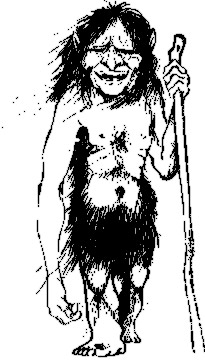
You’re probably not really half troll, but have some portion of troll blood, or are merely the result of a curse or potion misuse. You look like an abnormally tall, gangly, lumpy, warty human. People view you as a freak, but not a monster - at least until they see your severed head talking.

Hit Dice & Attack: as Fighter

Saves: as Fighter, except Breath is 1 worse and Poison is 1 better

Experience: 3,000 XP to 2nd level

Troll Blood: You regain 6 HP at the end of each hour, unless hungry.

Lumpy: You have a +1 bonus to AC, but you are unable to wear armour other than leather.

Monstrous Hunger: You must eat two rations each day, instead of only one. You can smell meat and rotting corpses inside a room through the door, and you can eat things that most people couldn’t (or wouldn’t).

Troll Weakness: You take one additional die of damage from fire or acid (so 1d4 becomes 2d4, 6d6 becomes 7d6, and so on), and you cannot use your Limbs Shall Be Severed ability for 1 exploration turn thereafter. If you are hit with an attack while you are surprised and holding a torch, you must save vs. Breath or take 4 damage from the flame.

Limbs Shall Be Severed: Starting at 4th level, when a melee attack would kill you, roll to lose a random body part instead. d5: 1 = left leg, 2 = right leg, 3 = left arm, 4 = right arm, 5 = head. That part is now severed, and you are at 1 HP rather than dead.

If you rolled a limb, it falls off dead from your body, and grows back after 1 day.
If you rolled the head, your body drops dead, while your head is still alive. You still have your senses, but you cannot move or act except for attempting to bite anyone holding you for 1d2 damage. Your body grows back after 1 week.

When forced to roll for a lost body part additional times, you die if you are just a head, and you also die if you roll a limb that’s already missing.


Image: CC SA 3.0 by www.cuco.com.ar

Friday, 8 March 2019

Random LotFP Class Generator

Random class generator
Random LotFP class generator. Credit to Emmy Allen for the numbers: http://cavegirlgames.blogspot.com/2019/01/i-did-maths-to-lotfp-classes.html (used with permission)
Lamentations of the Flame Princess is an OGL game by James Edward Raggi IV.

Changes I made: Rolled the "Fighter Tax" into the Fighter's attack progression. Rolled being innately Chaotic together with being unnatural and harmed by holy water. Did not include the Fighter's "max HP at 1st level" feature. Added an interest rate for high XP cost combinations. HD d12 costs 400 instead of 300 XP.


YOUR RANDOM LotFP CLASS IS...
THE _____________________ :


[class goes here]

All that we leave for you is to come up with the name for your class. Leave your suggestions in the comments below!

Thursday, 7 March 2019

Making the case for limited ability modifiers in OSR

D&D B/X is, I would wager, the most popular basis for OSR games. Therefore, B/X style ability modifiers are the most common. In case you didn't know, ability modifiers in B/X range from -3 to +3 and are determined like this:

Score Mod
3 -3
4-5 -2
6-8 -1
9-12 +0
13-15 +1
16-17 +2
18 +3


Nice, unified and symmetric. Except of course when it's not - only positive modifiers affect languages known, and reaction adjustments from Charisma only go from -2 to +2, and ditto for initiative adjustments from Dexterity. But we'll get back to that.

While this is probably the smoothest system in any official edition - more unified than Original and Advanced D&D's jumble of adjustments, and less game-deciding than WotC D&D's gigantic -5 to +5 range, they're not the best choice for everything.

Negative modifiers can be problematic when you want to modify numbers that are naturally quite small. Rulesets will often include things like “you can hold your breath for a number of minutes equal to 1+CON”, which will then require special stipulations and minimums for negative modifiers.

Also, I have witnessed applying modifiers to dice rolls cause headaches to OSR hackers creating their own games using B/X as a starting point (often via Lamentations of the Flame Princess). ‘Esoteric Enterprises’ and other games by Emmy Allen use X-in-6 skills like LotFP, except ability modifiers are applied to skills - though they can never go below 0-in-6 (rolled as a 1-in-36 chance). Since skills start at 1-in-6, this means that a modifier of -3 or -2 is the same as -1, not to mention that a +3 is pretty massive. The WIP post-apoc game Ruinations by Brent Ault has gone through several iterations with its skill system, likewise attempting to include ability modifiers into skills, but trying to dampen their effect. At one iteration of the ruleset, skills were moved up to the d12, starting at 2-in-12, plus ability mods. Once again, anything below a -1 is not accounted for. The skill system was changed in a later version to a d100 where start skills at 20%, and have each point of modifier count for 5%, so a -3 modifier would give a 5% success rate. Which, you'll notice, is mathematically the same as a d20 roll with the modifiers applying in their usual way.

Basically, the d6 skill system is liked (by me and many others) for its chunkiness - adding a pip to a d6 feels much better than adding a handful of points to a d20 - but big modifiers and big chunks don't mix.

I'm going to suggest something to all hackers, tinkerers and homebrewers right now:

Ditch the negative ability modifiers from your game. Completely.

It's okay. Just because you're using B/X as your engine doesn't mean you NEED to have the same ability modifiers. It doesn't break compatibility. You still have the same scores, in the same range of 3-18, for when you take ability damage or whatever. You can still run Keep on the Borderlands even if there isn't some unlucky geezer running around with a -2 DEX. You still have HP, and XP, and AC. You can still use all the great TSR and OSR content out there exactly the same.

Then, squish down the modifier ceiling to one that you think won't break your maths too much.

Yes, it may be somewhat more fun for players to have wide variation in characters' abilities, and amusing to laugh at the one chump with a big negative modifier. But reducing modifiers to a range of, say, +0 to +2, opens up a lot more design space for a homebrewer. Never again will you have to worry about special stipulations when applying modifiers to a base number of 1.

(Btw, this pairs quite well with the static Health/Wounds mechanic I talked about in an earlier post - I'll just have CON modifier increase your starting Health at level 1, but more on that in a later post.)

As for precedents, there are already places where B/X et al. restrict adjustments from abilities to -2 to +2, like reactions, initiative, and XP adjustments - because a +3 would be far too large a modifier on a 2d6 roll, for example. Why not expand these limits to everything, thus truly unifying ability adjustments? A smaller range of ability modifiers that excludes negatives means doing less maths, a larger design space, and fewer special cases.

I propose the following modifiers, and will use them in my next game:

Score Mod
3-12 +0
13-15 +1
16-18 +2


Essentially, it's the B/X range but with negatives completely removed, and +3 squished into +2. You still have some characters (21.3%) who are very good at a given thing, and a few (4.6%) who are exceptional at it. The rest (74.1%) are just average. And that's okay. Now, your base Bushcraft (or whatever) chance will be either 1-in-6, 2-in-6, or 3-in-6. No special stipulations.

By the way: in the oft-referenced late Gygaxian houserules for OD&D, abilities modify things by +1 or not at all. And they modify very few select things. Constitution of 15 or more gives +1 HP per HD, and so on. In discussions of these rules it is often pointed out that they were made for convention games, and therefore do not represent how Gygax ran the game at home. It is true that many of the changes there improve PC survivability - which makes sense when running a quick convention game. However, the streamlining and restricting the effect of abilities does not necessarily improve PC capability - and in fact set a lower ceiling for it than those in B/X and AD&D. I'm not going to say "if it's good enough for Gygax...", I'm just including it for completeness and to show that it's okay to do things differently to B/X - as long as compatibility is preserved. Compatibility must always be preserved.


Saturday, 1 September 2018

Simple OSR Thief skills on a d20

Observation 1: Most of the Thief skills in B/X D&D improve in increments of 5%, which makes using a percentile die rather pointless. You can take the percentile (and x-in-6) Thief skills table, convert all the values onto a d20 target number, and it looks like this (TN rounded up):

Level
Climb Sheer
Surfaces
Find/Remove
Traps
Hear
Noise
Hide In
Shadows
Move
Silently
Pick
Locks
Pick
Pockets
1
3
18
14
18
16
17
16
2
3
17
14
17
15
16
15
3
3
16
10
16
14
15
14
4
2
15
10
15
13
14
13
5
2
14
10
14
12
13
12
6
2
12
10
13
11
11
11
7
2
10
7
11
9
9
9
8
2
8
7
9
7
7
7
9
1
6
7
7
5
5
5
10
1
4
7
5
3
3
3
11
1
2
4
3
1
1
1
12
1
1
4
2
1
1
0
13
1
1
4
1
1
1
0
14
1
1
4
1
1
1
0

Observation 2: From this table it is easy to see that most of the skills - Find/Remove Traps, Hide in Shadows, Move Silently, Pick Locks and Pick Pockets - are always within a band of 2 points of each other. Generally, they start at 16-18, improve 1 point per level, before accelerating to a rate of 2 points per level starting at 5th or 6th level. These could very easily be collapsed into one chance without losing much precision - let’s say into the middle chance, Pick Locks, a 17.


One of the remaining two skills, Hear Noise is one that many tables including mine (and some retroclone rulesets) ignore, simply letting players succeed to listen if they spend a bit of time, so it can be ignored here. Climb Sheer Walls is a bit of a tricky one. It’s the only one that starts at a high chance of success, 87%, and improves by one percentage point per level, so it ill fits non-percentile models. However, there is precedent in the OSR of merging Climb into a more “unified” skill system, in LotFP, where Climb improves in steps of the same size as other skills. If Specialists put all their points at 1st level towards Climb, they end up with chances quite similar to the ones in B/X - good chances in climbing (5/6), terrible chances of doing anything else (1/6).

Hacking it


Let’s assume that in our modern mindset we want a resolution mechanic that can be applied not just to Thieves, but all classes, while still retaining Thief superiority. Naturally, we achieve that by treating all other characters as zeroth level Thieves. So, ignoring Climb for a moment, we choose a 17 as our target number at 1st level, increasing by one each level. In other words, to succeed at a Thief skill, you must roll d20 + Thief level for a result of 18 or higher.

Hell, why not call it a nice round easy-to-remember 15, and give Thieves a little boost? The B/X Thief is commonly seen as too inefficient, and in fact AD&D boosts many of the thieving chances by 10%. Now, doing this does improve all characters’ odds from the default 16.6% of LotFP to 30%. But, especially these days, most OSR play takes place in the low levels. I’m okay with letting characters do a bit more. (For comparison, the Mutants & Magic proposal linked above lets 1st-level Thieves succeed on most things on a 12-14+.) Incidentally, choosing 15 as the target number, the new chances start to fall behind the B/X Thief's at 8th-9th level.


"Most LotFP campaigns feature lower level characters, and modern campaigns do not last long enough to build characters to higher levels. ... providing characters more possibilities at lower level and decreasing the importance of gaining levels is important."
- James Raggi, "Playtest Notes" in Eldritch Cock

Now that we’ve moved all skills to this mechanic, the obvious next step is other “common activities” with X-in-6 odds like Foraging, which LotFP turns into the Bushcraft skill, and Open Doors, which is not a skill but an X-in-6 chance modified by Strength. Open Doors should certainly be modified by Strength in our new system too. One benefit of moving to the d20 is that if you want ability scores to affect the odds of skills, you can, simply by adding the ability modifier to the roll. Wisdom would be used for Bushcraft, Dexterity for Stealth, Intelligence for Tinker, and so on. The modifiers have a bit of an impact but do not overflow the die size. Also, we are now rolling high (like all other rolls), instead of rolling low on a d6 or percentile, if you care about that sort of unification/elegance nonsense. (I don't think the d6 is bad at all, personally, in fact I really like how chunky the increments feel.)

Finally, let’s get suspiciously modern and use the term “proficiency” for adding Thief levels to the roll. Thieves shall have proficiency in Stealth, Climb, and Tinker. If we take a leaf from LotFP’s increasing demihuman skills, then Dwarves would have proficiency with Architecture, Elves with Search, and Halflings with Bushcraft (and also have a +10 to hide in the wilderness). I would also probably give Fighters proficiency in Open Doors, because why not? They’re likely to be the most physical type.

A summary of the skill system


All activities and skills (Climbing Sheer Walls, Finding Traps, Removing Traps, Hearing Noise, Hiding in Shadows, Moving Silently, Opening Locks, Picking Pockets, Forcing Open Doors) are rolled on a d20. The appropriate ability modifier is added, as well as Thief level if the activity is thiefy. A result of 15+ is a success.

Skills/activities:
  • Architecture: INT, +Dwarf level
  • Bushcraft: WIS, +Halfling level
  • Climb: STR, +Thief level
  • Languages, Medicine: INT
  • Open Doors: STR, +Fighter level
  • Search: INT, +Elf level
  • Stealth, Sleight of Hand: DEX, +Thief level (these skills can be rolled into one)
  • Tinker: INT, +Thief level

(Sneak attack is no longer a skill, but a simple 2x multiplier, possibly increasing with Thief level.)

Now that all Thief activities progress the same, you can combine those that use the same ability, i.e. Stealth and Sleight of Hand. If you see Tinker (Pick/Remove Traps) as an activity requiring more dexterity than intelligence, then that can be merged in too for a general "Thievery" skill. As an extension of the system, you could have character backgrounds that give you background skills granting a +2 bonus to certain activities.

Pros & Cons


So what’s the score? We have made abilities slightly more important, which depending on your taste may be a good thing or a bad thing (but actually less important compared to roll-under ability checks). We now have a Thief and not a Specialist - we’ve removed “builds”, option paralysis, customization - which again you may see as either good or bad. We've made Thieves decent at everything, but far worse at climbing (I dunno, give them a +10 to climb or something if you want). As a positive, we’ve reduced the space taken up by skills on the character sheet, since you no longer need to list the individual skill levels, only whether you’re proficient in them - adding your level to the roll is easy enough. And there's no need to print a Thief skills table in the rulebook anymore.

However, I see some serious risks in going in this direction. Those risks are psychological shifts that may happen in dungeon masters when moving from a “X in Y” chance to a target number which has treacherous resemblance to the modern “d20 + proficiency vs. difficulty class” mechanic of 5e. The danger is that DMs will start to see the fixed target number of 15 as a "default DC" that they will begin to carelessly modify. They may be tempted to do this where they would not have been in a d6 skill system. LotFP's rules only mention modification of the chances in two places: opening giant stone doors, and attempting to forage in different terrains such as the desert. Modifying the target numbers too often may give rise to a treadmill where characters get more competent but DMs constantly raise the obstacles in response. Because... for some reason a locked chest in a high-level dungeon would have a higher DC to open? I am generally against that, and it should be used very sparingly, as LotFP does. Just let players know their chances of success, and let characters feel competent! This psychological risk of treadmills could perhaps be mitigated by pre-applying the modifiers and listing the naked die result required on the character sheet, as saving throws are handled, though that would take up a bit more space on the sheet and require updating every level.

The other risk is that it will tempt DMs to call for knowledge rolls, and perception rolls. Those are harmful too, but the explanation why is a subject for another blog.

Finally, I'd like to say that I'm not under the impression any of this is an original idea. The Thief seems to be one of those topics of eternal discussion. In fact I'm almost certain there are already several blogposts with same idea, but Google failed to find me any so I'm barfing my notes on here.